Travellers of the World Revolution by Brigitte Studer
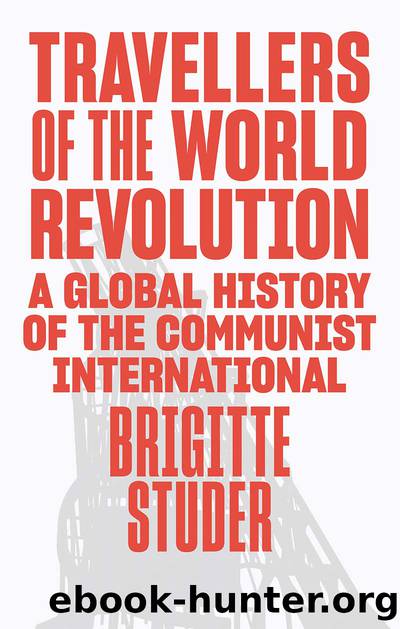
Author:Brigitte Studer
Language: eng
Format: epub
Publisher: Verso Books
Improvised Cooperation Between Apparatuses
The arrest of Rudnik and Moiseenko meant that the Shanghai office of the Pan-Pacific Trade Union Secretariat had to close down.85 The OMS station itself remained unstaffed until early 1932, and documentary exchange between Moscow and the Chinese party was halted. It was Richard Sorge (1895â1944, âRamsayâ) who, in the meantime, took over the liaison function. Ostensibly a newspaper correspondent, he led an ordinary, public life, unlike the two arrested chiefs of station, using his own name and enjoying close relationships with local diplomats and business people, though he had, in fact, been working in Shanghai on behalf of Soviet military intelligence since the winter of 1929â30.86 Lacking the appropriate experience, he had to take over responsibility for the local rezidentura in an emergency.87 This overlap of roles was a breach of the standard security requirements, even contact between party members and âneighboursâ, as the Comintern called those who worked for Soviet military intelligence, being out of the question. Sorge, however, was now linked with Moscow-based OMS staffer Karl Lesse (1894â?), the German former seaman hastily despatched to Shanghai in August 1931, and with Rylski, the only member of the Far Eastern Bureau remaining in the city.88 Lesse succeeded in partially restoring the flow of policy documents to the Chinese party, through the German bookshop Zeitgeist, a stopgap until a direct radio connection with Moscow could be re-established.89 This bookshop on the banks of the Suzhou River, seemingly part of Münzenbergâs business empire, was a meeting place for leftist intellectuals and an excellent place for people to leave messages for each other secreted in books.90 Its manager at that time was the young Irene Weitemeyer (1907â1978), who had studied at an international cadre school in the Soviet Union before going to work for the ECCI and the Peopleâs Commissariat for Foreign Trade.91 It was in Moscow that she had met her Chinese partner.
The real work of rebuilding fell to Rudnikâs successor, Nikolai Zedler (1876â1937?), an OMS operative of long standing. He had already done stints in Paris, Brussels, Berlin and Vienna, under the pseudonyms âHerbertâ, âErwinâ, âKurtâ and âNorskyâ. His first task was to restore the links with the Chinese party, the Soviet territories and Korea that had been broken by the exposure of the Noulens couple. He was also expected to re-establish contact with Japan and the Philippines and, if possible, with India and Indochina. To âlegalizeâ his position â by which the Comintern meant to establish cover for an undercover political operative â he presented himself as a member of the International Music Society and contacted the Shanghai Conservatory and the cityâs well-known musicians. This led to his finding employment as secretary to a Chinese professor of music who collected ancient Chinese texts on music and theatre. He also organized two performances of Chinese pantomimes, in connection with which he was even interviewed by the American press.92
The new head of the Far Eastern Bureau, the German Arthur Ewert mentioned earlier, arrived in September 1932 together with his wife Elise Saborowski, known as Sabo (1886â1939), another employee of the OMS.
Download
This site does not store any files on its server. We only index and link to content provided by other sites. Please contact the content providers to delete copyright contents if any and email us, we'll remove relevant links or contents immediately.
| Anthropology | Archaeology |
| Philosophy | Politics & Government |
| Social Sciences | Sociology |
| Women's Studies |
The Secret History by Donna Tartt(19092)
The Social Justice Warrior Handbook by Lisa De Pasquale(12190)
Thirteen Reasons Why by Jay Asher(8912)
This Is How You Lose Her by Junot Diaz(6887)
Weapons of Math Destruction by Cathy O'Neil(6281)
Zero to One by Peter Thiel(5802)
Beartown by Fredrik Backman(5756)
The Myth of the Strong Leader by Archie Brown(5508)
The Fire Next Time by James Baldwin(5447)
How Democracies Die by Steven Levitsky & Daniel Ziblatt(5219)
Promise Me, Dad by Joe Biden(5154)
Stone's Rules by Roger Stone(5088)
A Higher Loyalty: Truth, Lies, and Leadership by James Comey(4964)
100 Deadly Skills by Clint Emerson(4926)
Rise and Kill First by Ronen Bergman(4790)
Secrecy World by Jake Bernstein(4753)
The David Icke Guide to the Global Conspiracy (and how to end it) by David Icke(4720)
The Farm by Tom Rob Smith(4514)
The Doomsday Machine by Daniel Ellsberg(4490)
